ART GALLERY DEPICTING THE GODS AND GODDESSES, HEROES MONSTER OF BICOL MYTHOLOGY
Bicolano Pantheon of Deities
Bicolano Pantheon and Mythology
Bicolano mythology, deeply rooted in the Philippines, showcases a rich tapestry of gods, goddesses, and mythical creatures. Set in the Bicol Region's lush landscapes, the pantheon revolves around Gugurang, the supreme deity ruling Mt. Mayon. Asuang, the lord of darkness, embodies chaos, contrasting with Gugurang's benevolence.
The epic of Ibalong narrates Handiong's heroic deeds against mythical creatures, symbolizing Bicolanos' courage. Other deities like Oryol, Kalapitnan, and Katambay contribute to this intricate mythology. Bicolano rituals, like the Pantomina festival, connect the people with mythical beings.
Challenges in preserving Bicolano mythology arise due to modernization, impacting oral transmission. Comparisons to Hinduism reveal shared threads in Southeast Asian cultures. Mythological names hold cultural significance, resisting easy translation.
Key deities include Languiton (sky), Tubigan (water), Dagat (seas), and Paros (winds). Gugurang commands light and fire, while Asuang represents darkness. Lesser gods like Batala, Linti, Dologdog, and Magindang contribute to the divine tapestry. The dynamic narrative evolves through oral transmission, distinct from Western mythologies.
Haliya, Bakunawa, Onos, Okot, Kalapitnan, Kanlaon, Nagined, Apolaki, and Anito are additional gods embodying diverse aspects of nature and existence in Bicolano mythology. Oratihon, the demigod of the sun, adds further depth to this vibrant and evolving tradition.
The orally transmitted mythology of the Philippines is intended for sharing and understanding. It is a dynamic narrative tradition that evolves over time, distinct from the standardized mythologies found in Western and European cultures. Unlike these established mythologies, the Philippine government has not mandated standardized versions of stories and legends.
Orally transmitted stories undergo variations and evolve over time, resulting in numerous different versions. There are many different version told by Filipinos,and retold by Filipinos in and out of the Philippines. Support Local story tellers and Artist that promote not only Bicol mythology but Philippine mythology.
Bicolano Pantheon of Deities
LANGUITON BICOLANO GOD OF THE SKIES, THE SKY
LANGUITON (Langit) primodial Bicolano god representing the sky. sovereign of all the flying creatures in the skies. He associated with the clear blue skies that represent purity of soul, truth, and stability
 |
| LANGUITON |
 |
| LANGIT |
 |
| LANQUITON |
 |
| LANGUITON |
 |
| LANGUITON |
ADLAO BICOLANO MYTHOLOGY GOD OF THE SUN
 |
| ADLAO |
Adlao is the revered god of the sun in Bicolano mythology, associated with sunlight, heat, and good harvest. He symbolizes vitality and life-giving energy from the sun, depicted as a handsome figure with golden-brown skin. The worship of Adlao holds cultural and agricultural significance, reflecting the Bicolanos' deep connection to nature and their acknowledgment of the sun's role in sustaining life.
As a sun deity, Adlao is revered for his connection to divine and life-giving sunlight. Bicolanos may associate him with qualities like fertility, abundance, and prosperity, emphasizing his benevolent influence on agricultural endeavors.
Adlao's cultural significance extends to rituals and festivals woven into the Bicolano agricultural calendar. These celebrations seek blessings for bountiful harvests, expressing gratitude to Adlao for the prosperity he brings.
The story of Adlao in Bicolano mythology adds complexity to the impact of Spanish colonization, highlighting the clash of cultural beliefs. Despite attempts to distort Adlao's image, his legacy endures as a symbol of resilience and cultural identity.
In another narrative, Adlao's son, the unnamed sun demigod, fell in love with a mortal named Rosa. His fiery presence accidentally caused the destruction of Rosa's village, leaving only hot springs as a reminder of their tragic love story.
It's essential to respect the dynamic nature of Philippine mythology, recognizing variations in the retelling of stories and the importance of understanding rather than appropriating these cultural narratives.
 |
| Bicolano god of the Sun ADLAO |
 |
| ADLAO |
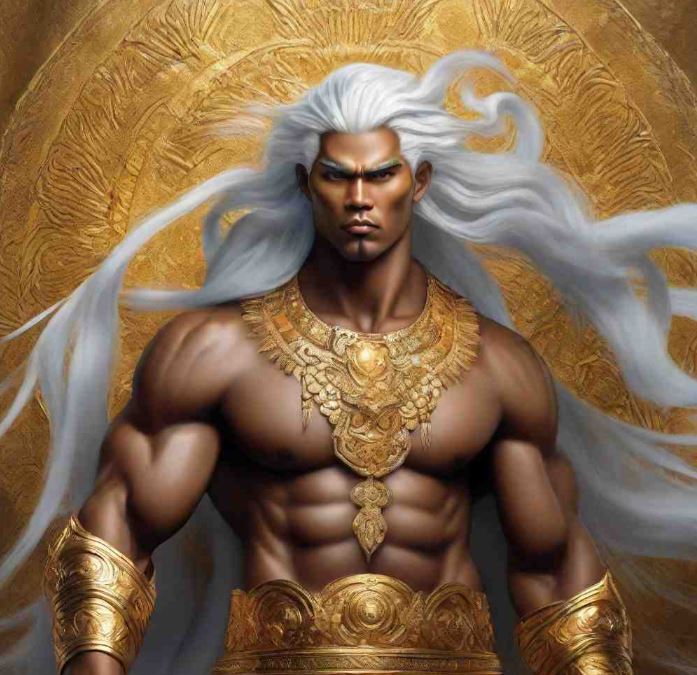
Gugurang - the supreme deity in Bikolano mythology, stands as a symbol of justice, fairness, and power.
 |
Gugurang the supreme deity in Bikolano mythology |
 |
| Gugurang the supreme deity in Bikolano mythology |
Gugurang is the supreme deity in Bikolano mythology, known for his fairness and justice. Described as muscular and tall with silver hair, he commands obedience and is associated with the fire that warms Mount Mayon. Originating from the divine embodiment of winds, Gugurang asserted dominance over his brothers and became the ruler of the heavens.
Gugurang's fire, both literal and symbolic, represents knowledge and power. His subordinates, Lightning (Linti) and Thunder (Dalogdog), symbolize punishment. Gugurang also commands winged guardians, the Katambay, and the Katambang, half-man half-bird creatures.
The narrative unfolds with Gugurang facing challenges from Asuang, an opposing force seeking to defy Gugurang's authority. The clash involves stolen fire, battles, and Gugurang's eventual triumph with the help of his winged guardians.
In another story, Gugurang interacts with Bulan, the lunar deity, showcasing a harmonious relationship between the supreme god and the gentle, playful Bulan. Overall, Gugurang's role in maintaining order and justice, coupled with his interactions with various mythological beings, contributes to the rich cultural tapestry of Bikolano mythology.
 |
| GUGURANG |
 |
| Gugurang the supreme deity in Bikolano mythology |
 |
| GUGURANG |
 |
| GUGURANG |
 |
Gugurang the supreme deity in Bikolano mythology
 | | OKOT |
OKOT
In Bicolano mythology, Okot is revered as the god of forests, birds, and the hunt. Associated with astuteness, wisdom, and craftiness in hunting, Okot was originally depicted as a tall, muscular man with brown skin, adorned with beautiful leaves and skilled in using a bow and arrow. However, the arrival of the Spanish colonizers led to the distortion of Okot's image. The Spaniards, pushing their puritanical ideology, portrayed Okot as a small and puny forest spirit, attempting to belittle this once towering deity. Despite these efforts, Okot remains a symbol of resilience in Bicolano mythology, highlighting the enduring power of cultural identity and the complex interplay between indigenous beliefs and external influences. |
 |
| OKOT |
 |
| OKOT |
 |
| OKOT |
 |
| OKOT |
 |
| OKOT |
 |
| OKOT |
 |
| OKOT |
 |
| OKOT |
Haliya - Moon goddess, goddess of Moonlight
 |
| Haliya |
.jpg) |
| Haliya |
Haliya is a goddess worshipped in Bicol, known as the warrior goddess of moonlight and the arch-enemy of the dragon Bakunawa. She is the sister or daughter of Bulan, the god of the pale moon, and they are both revered for their radiant beauty. Haliya is depicted as strong and adamant, wearing a mask to hide her beauty.
Masked goddess of the Moonlight. Haliya is most known as the masked goddess of the Moon and archenemy of the Bacunawa
Haliya in the legends she was worshipped by cults of women and symbolizes strength
Haliya's most notable conflict is with Bakunawa, a dragon who sought to devour the moon. The battle between Haliya and Bakunawa is a recurring theme in Bicolano mythology, resulting in Bakunawa being punished and trapped in dragon form.
The celestial gods, including Haliya and Bulan, are associated with flowers like the water hyacinth and lotus in Bicol. The legend of the Takay flowers tells the story of a maiden turned into flowers by Haliya and Bulan. The lotus flowers are associated with Bulan dipping into monster-infested waters and symbolize spiritual enlightenment and rebirth.
The Bicolano myth also tells of Bakunawa's initial admiration for Bulan, leading to a transformation into a colossal fish-dragon in an attempt to claim him. Haliya, convinced by wind nymphs, descends to the waters of Bicol, initiating Bulan's nightly descends from the heavens. The ongoing cosmic struggle between Haliya, Bulan, and Bakunawa is depicted in celestial phenomena like lunar eclipses. This mythical tale explores themes of love, jealousy, and the eternal battle between light and darkness.
.jpg) |
| HALIYA |
.jpg) |
| HALIYA MOON GODDESS |
.jpg) |
| HALIYA |
.JPG) |
| HALIYA AND BULAN |
.JPG) |
| HALIYA AND BULAN |
.JPG) |
| HALIYA AND BULAN |
.JPG) |
| BULAN AND HALIYA |
.jpg) |
| HALIYA |
.jpg) |
| BULAN AND HALIYA |
.jpg) |
| HALIYA AND BULAN |
.jpg) |
| HALIYA |
.jpg) |
| HALIYA |
 |
| HALIYA masked goddess of Moonlight |
 |
| HALIYA MOON GODDESS |
DAGAT
.jpg) |
| dagat |
Dagat, the Bicolano goddess of the sea, symbolizes the delicate balance between the elements in a cosmic dance. Born from the union of Laguit (goddess of water) and Paros (the wind), Dagat ruled over the seas with her divine partner. Their love, so profound, led to the birth of four children, each embodying aspects of the natural world.
.jpg) |
| DAGAT |
 |
| dagat |
.jpg) |
| dagat |
ONOS
 |
| ONOS |
 |
| ONOS |
ONOS - Onos the deity in Bicol mythology that freed the great flood, the Bikolano god of storms and deluge, was both venerated and feared in Pre-colonial Bicol. Described as a tall and muscular deity with an ill-tempered and childlike demeanor, Onos commanded the winds and brought destructive floods. Revered as a protector against invaders, Onos played a pivotal role in the mythology of Ibalong, unleashing his wrath upon those who dared to approach. His tragic love story with Takay, a mortal maiden, led to catastrophic events, including the sinking of Mt. Asog and the flooding of colonies. The tale concludes with the creation of the Takay flower, a symbol of undying love and a testament to the cosmic forces that shaped the destiny of gods and mortals. Additionally, Onos' impact on the monster Rabot further illustrates the intricate interplay between divine beings and the natural world in Pre-colonial Bicol.
 |
| ONOS |
 |
| ONOS |
 |
| ONOS |
BULAN
Bulan, the primordial god of the moon in Pre-Hispanic Bicolano mythology, is known for his androgynous beauty and luminous presence. Revered as the sibling of Haliya, the goddess of moonlight, Bulan is described as fair-skinned with dark eyes and hair, captivating even the vicious mermaids and beasts. Worshiped alongside Asuang by the baylan, he played a role in various myths, including a feud with Adlao, the sun god, symbolizing the eternal cycle of day and night.
 |
| BULAN |
 |
| BULAN |
 |
| BULAN |
The legend of the Takay flower is associated with Bulan, emphasizing its spiritual symbolism and connection to the rebirth of the moon. Additionally, Bulan's inadvertent creation of water nymphs, Tawong Lipod, showcases the dual nature of these spirits—some benevolent, others malevolent.
 |
| LINTI AND DOLOGDOG |
In Bicolano mythology, Linti and Dologdog, divine enforcers of Gugurang, the god of Mount Mayon, play crucial roles in maintaining cosmic balance. Linti, representing lightning, appears as a handsome young man with a thousand silver spears, symbolizing his control over lightning. Dologdog embodies thunder, riding a storm cloud with fierce expressions. Together, they serve in enforcing divine justice.
 |
| LINTI AND DOLOGDOG |
 |
| LINTI |
 |
| LINTI |
 |
| DOLOGDOG |
 |
| DOLOGDOG in Bicol mythology the deity that weilds Thunder, has the booming voice |
 |
| LINTI AND DALOGDOG |
In a conflict against the malevolent deity Asuang, who attempts to steal sacred fire, Linti and Dologdog are dispatched by Gugurang. Despite Asuang initially succeeding, a cosmic clash marked by thunder and lightning ensues. The divine brothers eventually assist Gugurang in reclaiming the stolen fire, defeating Asuang and restoring cosmic order.
Another tale involves Linti confronting the mighty mountain beast Apolaki, immune to fire. With the combined efforts of Linti and Dologdog, they successfully defeat Apolaki and seal it inside a mountain, ending its reign of terror.
 |
| LINTI |




.jpg)
.jpg)
.jpg)
.jpg)
.jpg)
.JPG)
.JPG)
.JPG)
.JPG)
.jpg)
.jpg)
.jpg)
.jpg)
.jpg)
.jpg)


.jpg)
.jpg)
.jpg)
.jpg)


.jpg)