Bakunawa and the Seven Moons (southern Bicol)
Long ago god created the seven moons to give light and beauty to the night sky, each moon had a deity as an embodiment. (Libulan,Haliya,Subang,Banolor,Banilig,Bulan,Mayari)
One night she saw the seven moon and was captivated by their beauty and longed to possess them. One of the embodiments of the moon descended to the sea to swim with the mermaids, it was Bulan - the adolescent aspect of the moon. Bulan was so comely with his long dark hair and his eyes darker than midnight, and his luminous fair skin that the vicious magindara became tame upon seeing his radiant beauty. the boy moon did not notice Bakunawa, thinking the boy had ignored her beauty to play with the mermaids enraged her. The following night she transformed herself into a dragon so she could devour the moons. Her dragon form was sea serpent with a mouth the size of a lake, a red tongue, whiskers, gills, small wires at its sides, and two sets of wings, one is large and ash-gray while the other is small and is found further down its body.
THE SEVEN MOONS IN REALITY
the seven Moons were decoded by Scientist which tells that of lunar phases,Waxing,First Quarter,Waxxing Gibbous,Full Moon,Wanning Gibbous,Third Quarter, and Wanning Crescent
The new moon, referred to as "subang," The moon looks like a crab shell. They used the term ''banilig'' "balirig" to describe this phase.The full moon, or the moon in general is known as '' bulan'' or "dayaw," was celebrated for its perfect and praiseworthy brilliance from sunset to sunrise. As it began to wane, setting just before dawn, it was called "banolor," symbolizing a transition or exchange, akin to a passing of the torch from one generation to the next.
Halya to Haliya the arc nemesis of Bacunawa
The ancient ritual of Halya, once a simple celebration of the full moon, gradually transformed over time into a mythical summoning of the goddess of the Moon, known as Haliya. As stories and myths evolve through generations, the Halya ritual took on deeper spiritual significance, incorporating elements of divine intervention and protection. As the ritual evolved, so too did the mythology surrounding it. Over time, the people began to personify the protective forces of the moon, giving rise to the concept of Haliya, the goddess of the Moon. Haliya became a symbol of strength and defense, defending the male lunar deity Bulan from the threat of the Bacunawa
"Halia" was a ritual performed during the full moon. Tribespeople would exit their homes, gather in the streets, and create a cacophony of noise to deter the serpent Bakunawa from devouring the moon. The ceremony also aimed to dispel malevolent spirits.
Summoning the Moon goddess in myths to battle the Bacunawa
The ancient ritual of Halya, once a simple celebration of the full moon, gradually transformed over time into a mythical summoning of the goddess of the Moon, known as Haliya. As stories and myths evolve through generations, the Halya ritual took on deeper spiritual significance, incorporating elements of divine intervention and protection.
 |
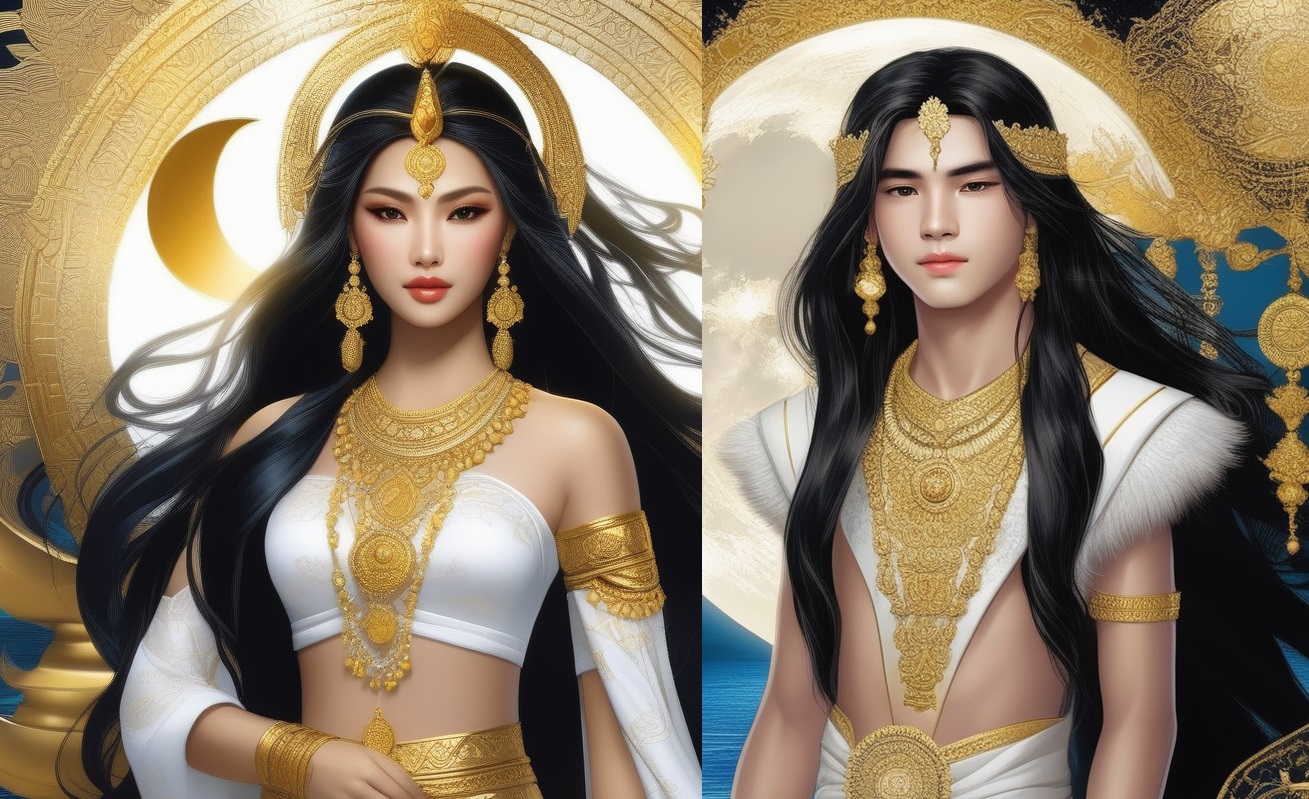
| Bulan and Haliya |
Originally, the festival of Halya was marked by extravagant festivities, characterized by the thunderous noise of drums, tambourines, and hollowed-out logs. The purpose of the celebration was to honor the full moon and ward off the threat of the Baconaná (Bakunawa), a feared creature believed to devour the moon, plunging the world into darkness. The disappearance of the moon during eclipses reinforced this belief, as the people interpreted it as evidence of the Baconaná's influence.
As the ritual evolved, so too did the mythology surrounding it. Over time, the people began to personify the protective forces of the moon, giving rise to the concept of Haliya, the goddess of the Moon. Haliya became a symbol of strength and defense, defending the male lunar deity Bulan from the threat of the Bacunawa
In the revised narrative, participants in the Halya ritual not only celebrated the beauty of the full moon but also invoked the protective powers of Haliya to safeguard their world from darkness and disaster. The ritual took on a deeper spiritual significance, as participants believed they were actively engaging with divine forces to ensure the prosperity and well-being of their community.
The culmination of the ritual was marked by feasting and revelry, as participants indulged in tuba and enjoyed the bounty of the land. However, underlying the festivities was a sense of reverence and awe for the mythical beings they invoked and the cosmic forces they sought to appease.
Thus, the ancient ritual of Halya transformed into a mythical summoning of Haliya, the goddess of the Moon, as the people's beliefs and traditions evolved over time.
Laho the moon eater in Tagalog mythology
Laho is a mythical serpent, similar to the Bakunawa in the Bisayas and in Bikol, known as a Naga God that is believed to cause solar and lunar eclipses by devouring the sun and moon. To ward off Laho and free the celestial bodies, people would create loud sounds by playing music, banging pots, and using gongs.
An account from 1731 by Tomas Ortiz mentions an eclipse in Pagsanjan, Laguna province, where the locals played the kulingtang, a musical instrument, to scare away the serpent deity. The belief in Laho is thought to have been introduced to the Tagalog through the Hindu god Rahu, who, like Laho, is a serpent deity causing eclipses by consuming the sun or moon as revenge towards Vishnu.
Bakunawa in Tagalog Myths
Similar to all stories in the archipelago the Tagalog people believed in the seven moons created by Bathala (Supreme deity) and the Bakunawa captivated by the moons tried to devour them, when the gigantic fish-serpent was about to devour the last moon Bathala intervened and punished the Bakunawa banishing it back to the depths of the ocean
Bakunawa in NCR myths
In these seven moons, a colossal sea serpent named Bakunawa becomes enchanted by their beauty and attempts to devour them. However, each moon he swallows melts away, angering the creator Bathala. As punishment, Bakunawa is condemned to remain a beast and forbidden from devouring the last moon. Legend has it that he occasionally tries to eat the final moon, turning it red, but people on Earth unite to startle him or lull him to sleep with music to prevent this calamity. The story is a timeless tale of celestial wonders, forbidden desires, and the harmonious efforts of humanity
Bakunawa in modern day stories popular in Southern luzon
Once upon a time, in a world with seven enchanting moons, each ruled by a celestial deity, there lived a colossal sea serpent named Bakunawa. This serpent resided in the depths of the ocean, hidden away from the wonders of the night sky.
One fateful night, Bakunawa gazed upon the moons, captivated by their celestial beauty. Overwhelmed by desire, he yearned to possess these radiant orbs. Rising from his watery abode, Bakunawa soared into the sky, determined to devour the moons and make them his own. With great pride, he returned to the ocean depths, believing he had accomplished a mighty feat.
To his dismay, Bakunawa soon discovered that the moons within him were fading away like melting candle wax. Undeterred, he yearned for a moon that would endure. Night after night, he ascended to the heavens, swallowing one moon after another. However, each time, the moon melted away inside him, leaving him with empty longing.
Bathala, the supreme creator of all, witnessed Bakunawa's reckless actions and was filled with fury. Instead of ending the serpent's life, Bathala decreed a punishment that would last for eternity. Bakunawa was condemned to remain a beast and forbidden from devouring the last remaining moon.
Legend has it that Bakunawa, bound by Bathala's command, occasionally succumbs to the temptation of swallowing the final moon. This forbidden act turns the moon a fiery red. In response, the people on Earth unite in a cacophony of clanging metal, screams, and wails to startle the serpent into spitting out the moon. Others opt for a gentler approach, lulling Bakunawa into a deep sleep with soothing music, hoping the moon will roll out of his mouth peacefully. And so, the celestial dance between the heavens and the earth continues, a timeless tale of moons, serpents, and the harmonious efforts of humanity.
Bakunawa in Visayan Myths
In Visayan myths, the bacunawa is a monstrous eel dragon-like serpent from the sea that causes eclipse and misfortune. Bakunawa who coveted the moons is also a symbol of fortitude and strength and of strong will. For Bakunawa defied everything to posses the moons.
words for the seven and more phases of the Moon in Visayas
Here's the moon's phases in Old Waray/Bisaya from 1617, according to Padre Matheo Sanchez and summarized by historian William Henry Scott:
Day after new moon: The moon is just starting to appear. They called this "subang" or "kilat-kilat," which means it looks like a little lightning flash.
1-2 nights after subang: The moon is getting bigger. They used words like "gimata" or "ungut," comparing it to a baby opening its eyes or closing its mouth.
3 nights after subang: The moon is higher in the sky. They called this "hitaas na ang subang."
4-5 nights after subang: The moon looks like a crab shell. They used the term ''banilig'' or"balirig" to describe this phase.
1st quarter half-moon: The moon is directly overhead. They called it "udtu na ang bulan."
Waxing: The moon is getting bigger. They used the word "lakad" to describe this phase.
Between half and full: The moon looks lopsided, like a crab shell. They might say it's "na" or "maalimangu na."
Full moon: The moon is completely round and bright. They used terms like "takdul," "paghipunu," "ugsar/ugsad," or "dayaw" to describe it.
Waning, 1-2 nights after full moon: The moon starts to get smaller again. They called this phase "banolor/banulur/banulud."
5-6 nights after full moon: The moon continues to shrink. This phase is called "parik."
3rd quarter half moon: The moon has passed another milestone. They called it "katin."
Day 24-25 of the month: The moon is preparing for a new cycle. They called this "lakad na ang magsag-uli."
Day 29 of the month: The moon disappears completely. They called this "malasumbang," or the dark of the moon.


.jpeg)


.jpeg)





.jpeg)
.jpeg)


.jpeg)
.jpeg)
.jpeg)
.jpeg)
.jpeg)
.jpeg)

